The Terrible Indian Wars of the West by Keenan Jerry;
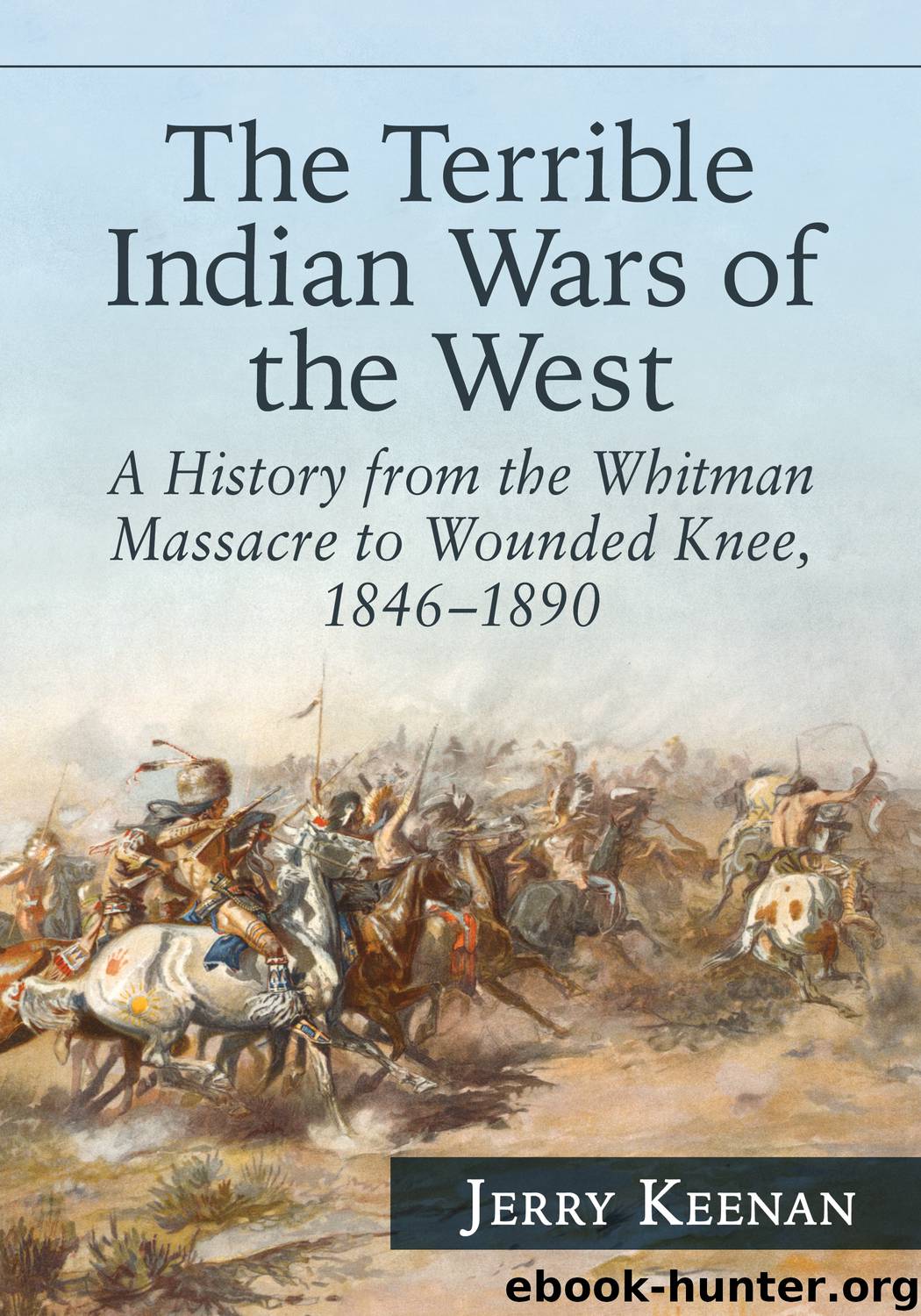
Author:Keenan, Jerry;
Language: eng
Format: epub
Publisher: McFarland & Company, Inc., Publishers
Published: 2016-04-15T04:00:00+00:00
Conflict on the Northern Plains: War with the Arickaras
I deplore the death of those of my brave Countrymen who fell victim to the scalping knife of the A’rickaras.—Benjamin O’Fallon, June 19, 18231
For the most part, clashes between trappers and tribes of the region did not involve the U.S. Army. However, an exception to that occurred in 1823 when a party of Rees attacked a trapping brigade in the employ of one, William Henry Ashley. Given the fledgling U.S. government’s concern about protecting its interests in this region, military intervention was deemed warranted.
As a consequence, in the spring of 1823 Col Henry Leavenworth, commanding the 6th Infantry at Fort Atkinson, Nebraska (Council Bluffs), moved up the Missouri River with a 200-man force and two pieces of artillery in relief of the Ashley party. Meanwhile, the Blackfeet, scourge of the mountain men, had also attacked a party of trappers along the Yellowstone River and killed seven. This turn of events resulted in another 100 reinforcements sent to Leavenworth, who, in the meantime, was joined by 50 trappers, led by one Joshua Pilcher of the Missouri Fur Company. Augmenting this force was a party of 750 Sioux—hereditary enemies of the Arikara. Perhaps harkening back to General Anthony Wayne’s “Legion of the U.S.” Leavenworth decided to call his expedition the “Missouri Legion.”
The Arikaras were grouped in two pallisaded or walled villages. As the expedition approached, the Sioux, ranging out ahead attacked and forced the Rees to retired behind their palisade. Arriving with his troops, Leavenworth surrounded both villages. After lobbing a few shells into the villages, Leavenworth prepared an all-out assault but then changed his mind, notwithstanding the pleas of his officers and especially the Sioux, who hungered for an attack. Leavenworth, however, stood by his decision, hoping that the Rees might be persuaded to talk peace without a fight. Disgusted, the Sioux pulled out. But Leavenworth’s patience paid off and on August 11, the Rees signed a peace treaty, but did so knowing that the American traders wanted more in the way of satisfaction than simply a signature on a piece of paper. That night the Arikaras burned their villages and fled west out of harm’s immediate way. Casualties on both sides were negligible, with Ashley’s company having suffered the loss of fifteen. Leavenworth reported no casualties and soon took his command back down the river to St. Louis. The whole affair was called a war, though it scarcely deserves to be tabbed as such.
Download
This site does not store any files on its server. We only index and link to content provided by other sites. Please contact the content providers to delete copyright contents if any and email us, we'll remove relevant links or contents immediately.
| Anthropology | Archaeology |
| Philosophy | Politics & Government |
| Social Sciences | Sociology |
| Women's Studies |
The Great Music City by Andrea Baker(33723)
Cecilia; Or, Memoirs of an Heiress — Volume 1 by Fanny Burney(32726)
Cecilia; Or, Memoirs of an Heiress — Volume 2 by Fanny Burney(32090)
Cecilia; Or, Memoirs of an Heiress — Volume 3 by Fanny Burney(32068)
We're Going to Need More Wine by Gabrielle Union(19178)
All the Missing Girls by Megan Miranda(16740)
For the Love of Europe by Rick Steves(14940)
Pimp by Iceberg Slim(14805)
Bombshells: Glamour Girls of a Lifetime by Sullivan Steve(14223)
Norse Mythology by Gaiman Neil(13576)
Talking to Strangers by Malcolm Gladwell(13559)
Fifty Shades Freed by E L James(13353)
Mindhunter: Inside the FBI's Elite Serial Crime Unit by John E. Douglas & Mark Olshaker(9532)
Crazy Rich Asians by Kevin Kwan(9422)
The Lost Art of Listening by Michael P. Nichols(7623)
Enlightenment Now: The Case for Reason, Science, Humanism, and Progress by Steven Pinker(7441)
The Four Agreements by Don Miguel Ruiz(6919)
Bad Blood by John Carreyrou(6747)
Weapons of Math Destruction by Cathy O'Neil(6483)
